
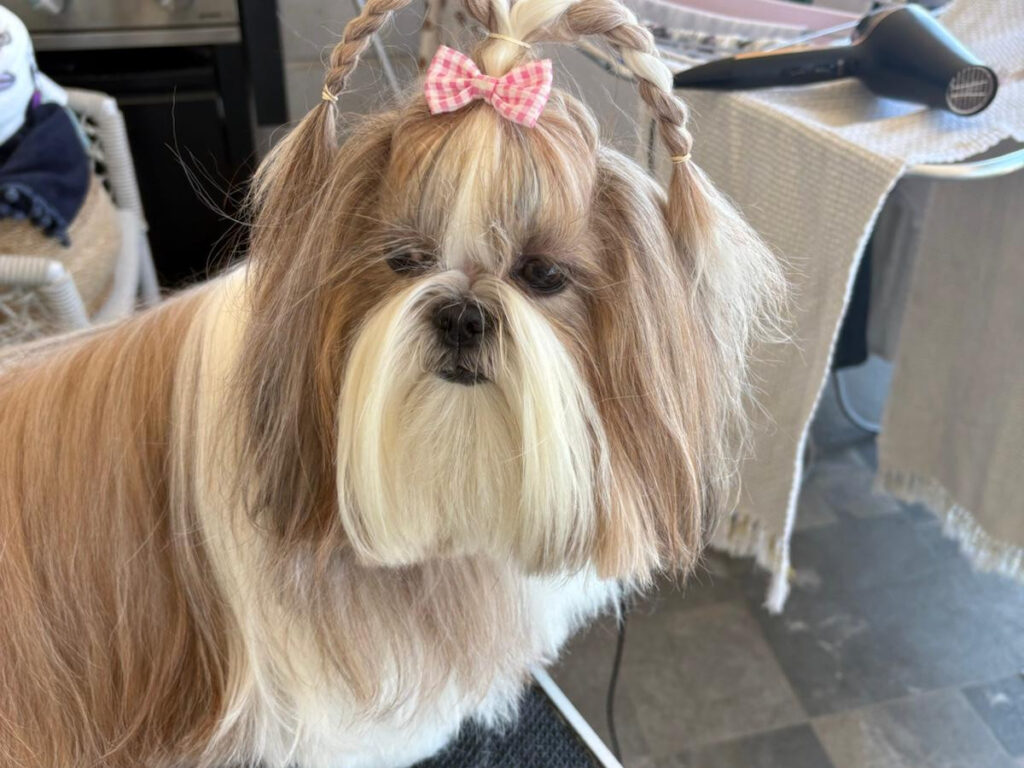
The first time you switch a clipper on beside a dog, you learn something about them in about two seconds. Some barely lift their head. Some are gone, out of the room, under a bed, and will remember the sound for a year. Which one you have decides most of what follows, and you cannot find out by reading.
So this is written as a sequence rather than a list of tips, because that is how a clip actually goes wrong. Almost every bad home haircut is a step done out of order, not a bad tool.
A Week Before You Switch Anything On
Two questions come before any equipment.
The first is whether your dog has a coat that should be clipped at all. Poodles, Bichons, Shih Tzus, Cockapoos and the other continuously growing coats need cutting because the hair does not stop. A double coat — a Husky, a German Shepherd, a Golden Retriever, a Corgi — does not. Clipping a double coat removes the guard hairs that shade the skin and leaves the undercoat that traps heat, and it can grow back patchy and different. If your dog moults in clumps twice a year, they need brushing out, not clipping.
The second question is whether your dog will tolerate the noise. Spend the week finding out. Switch the clipper on in another room while they eat. The next day, the same room. Then across the room while you sit with them. You are not clipping anything; you are teaching them that the sound predicts nothing bad. Skip this and you will spend the rest of the dog’s life fighting them for every haircut.
The Morning Of, and the Test That Decides Everything
Brush the whole coat out, then comb it. The comb is the test: if it will not pass from skin to tip anywhere, that spot is matted, and a matted coat changes the plan completely.
You cannot clip through a mat. The blade will not cut it, so it drags the mat, and the mat pulls the skin. That is how home clipping produces cuts — not from the blade touching skin, but from skin being tented up into it. A badly matted dog is a groomer’s job, and often a shave-down under sedation, which is a decision for them and your vet rather than for you and a $30 clipper.
The coat also has to be clean and bone dry. Dirt blunts blades faster than anything else, and damp hair clogs them. If you are bathing first, dry to the skin and give it an hour. The brushing and bathing order is worth getting right before you add a clipper to it.
Where the Dog Stands
The floor is the problem. On the floor a dog can walk off, sit down, or turn round exactly as you reach the tricky bit, and you will end up chasing the coat instead of cutting it.
Most people work on a table with a non-slip mat, at a height where their own back is straight. If your dog will not hold a stand, a grooming arm that clamps to the table keeps them upright and facing the same way.
Both are restraints, and restraints have one rule that does not bend: you do not leave. Not to answer the door, not to fetch something from the next room. A dog on a grooming loop can slip off a table edge, and there is no version of that story that ends well. If you need to walk away, take them off first.
Restraint also does not fix fear. A dog fighting the loop is telling you something, and tightening it is the wrong answer. Stop, and go back to the week of desensitisation.
Pick the Length Before You Start, Not Halfway Through
Guide combs set how much hair is left behind. Longer combs are more forgiving, hide unevenness, and are much harder to injure a dog with. Shorter blades sit closer to skin, cut faster, and are where the mistakes live.
- Start longer than you think you want. You can always take more off; you cannot put it back
- A summer clip does not need to be short — hair to about an inch still lets air move and still shades the skin
- Change combs, not pressure. Pressing harder does not cut shorter, it just heats the blade
- Whatever length you choose, use it on the whole body, then reassess
The other reason to start long is that you have not yet met this dog’s skin. Older dogs, thin-coated dogs and dogs with any lump, wart or skin tag need clearance the comb provides and the bare blade does not.
A cordless dog clipper with two speeds, a detachable blade and eight metal guide combs from 1/8 to 1 inch, so starting long, as above, is possible from the first session. The listing sells it for matted coats; a dog matted to the skin is still a groomer's job. A detachable blade also means a spare can be bought and swapped in when the first one heats.
As an Amazon Associate I earn from qualifying purchases.
The First Pass
Work with the lie of the coat, from the neck down the back, then the sides, then the belly and legs. Hold the blade flat against the body. The single most common home-clipping injury comes from tipping the clipper so a corner of the blade digs in, which happens naturally when you go round a curve.
Move slowly and overlap each pass by about half its width. Short choppy strokes leave tram lines. Long slow ones do not.
This is the point where a proper clipper earns its price. A cheap trimmer stalls in dense hair, and a stalling blade pulls before it cuts — which the dog feels, and remembers. A clipper with enough motor for a full body clip is the difference between one calm session and a dog who fights you next time. It is still not a professional machine, and it will not rescue a coat that should have gone to a groomer.
Free skin as you go. Loose skin on the belly, in the armpits and around the sanitary area folds under the blade if you do not hold it taut with your other hand. Stretch it flat, then cut.
Blade Heat, Which Nobody Warns You About
A clipper blade gets hot. Not warm — hot enough to burn, and fast, and your dog will not necessarily tell you before it happens. Clipper burn is a real veterinary presentation and it does not look like much at the time.
The check is simple and you should do it more often than feels necessary: stop every couple of minutes and hold the blade flat against the inside of your own forearm. If you would not leave it there, it does not go back on the dog. Let it cool, or swap to a second blade if you have one.
- Heat builds fastest on dense coats and on the second half of a session
- Blade coolant spray works, but stopping works better and costs nothing
- Redness, a raised patch or a dog licking one spot repeatedly afterwards is a vet call, not something to watch for a week
The Face, the Feet and the Sanitary Area
Everything so far has been the easy part. These three are where home grooming either stays fine or becomes a story.
Around eyes, ears and paws the clipper usually comes off and scissors go on, because you need control the clipper cannot give. That is also exactly where scissors are dangerous: a dog moves faster than your hand, and a point near an eye is a point near an eye. Curved shears held flat, cutting along the face rather than towards it, are the safest way to do this at home — a set with curved and thinning shears exists for this reason rather than as an upsell on a single pair.
The set Bell's coat is trimmed with: straight, curved and thinning shears, all 6.5 inches with round safety tips, plus a comb and a case. Hold the curved pair flat and cut along the face, never towards it. If you are not confident with scissors near a moving dog, read the next paragraph before you order.
As an Amazon Associate I earn from qualifying purchases.
And here is the honest line: if you are not confident with scissors near a moving dog, this is the part to hand over. A groomer doing faces and feet while you do the body at home is a perfectly sensible arrangement, and it costs a fraction of a full groom. There is no prize for doing all of it yourself.
Feet need the pad hair trimmed level with the pads, not scooped out of the gaps. Sanitary trims stay short and blunt-ended. Ears are thin and fold in ways you will not expect — feel where the edge is with your fingers before any blade goes near it.
Blending, and Knowing When to Stop
Clipper work leaves lines where one length meets another. Thinning shears break those lines up: they remove some hair and leave the rest, so the edge softens instead of stepping. Cut into the line at an angle, not across it, and take less than you think.
Then stop. The strongest instinct at the end of a clip is to keep tidying, and every pass makes the coat shorter and the mistakes bigger. Put the tools down, let the dog shake out, and look again in an hour. Most of what looked uneven has settled.
Afterwards
Brush the loose hair out, check the skin over with your hands for anything raised or sore, and do the nails another day — a dog who has just stood for forty minutes has spent their patience.
Then clean the blade. Hair and skin oil sit in the teeth, and a blade left dirty dulls faster and pulls next time. Brush it out, oil it, and store it dry. Blades are consumable: they will need replacing or sharpening eventually, and the day yours starts pulling instead of cutting is the day it needed doing a fortnight ago.
Everything we list for coats and clipping, brushes through to clippers and shears: Grooming.