
Ask ten owners what a dog can eat and you will get ten answers, most of them half right. The confusion gets worse when size enters the picture, because people assume small dogs and big dogs need completely different food. They mostly do not. What changes with size is not the list of safe foods but the margin for error, and that difference is large enough to matter every single day.
This guide covers both. If you have just brought a dog home, start at the beginning and stop after the portion tables. If you have had dogs for years, the later sections on large-breed puppy growth, bloat, body condition scoring and the grain-free debate are where the useful detail sits.
The One Idea That Explains Most of the Difference
A toxic food is toxic to every dog. Chocolate does not become safe because a dog is large. What changes is dose relative to body weight. The same square of dark chocolate that a Labrador would shrug off can put a Chihuahua in an emergency clinic, because the Chihuahua is receiving roughly nine times the dose per kilogram.
The same logic runs in reverse for calories. A single cheese cube might be two per cent of a big dog’s daily intake and twenty per cent of a small dog’s. Owners of small dogs are rarely overfeeding on purpose. They are simply feeding a body that has far less room to absorb extras.
Beyond dose, four real physical differences separate the two ends of the size range: growth rate, dental crowding, stomach anatomy and metabolic rate. Everything else in this guide follows from those five things.
Start Here: Foods That Are Never Safe
This table applies to every dog regardless of size. Nothing here has a safe serving. If your dog eats any of it, the response is to call your vet or an animal poison line, not to wait and see.
| Food | What it does | Signs to watch for |
|---|---|---|
| Xylitol (also sold as birch sugar) | Triggers a massive insulin release, crashing blood sugar. Higher doses cause liver failure. | Weakness, staggering, collapse, seizures, often within 30 minutes |
| Chocolate | Theobromine and caffeine overstimulate the heart and nervous system | Vomiting, restlessness, racing heart, tremors, seizures |
| Grapes, raisins, sultanas, currants | Can cause sudden kidney failure. Sensitivity varies enormously between individuals | Vomiting, lethargy, reduced or absent urination after 24 to 72 hours |
| Onion, garlic, leek, chives | Damage red blood cells, causing anaemia. Effect is cumulative over days | Weakness, pale gums, rapid breathing, orange-tinged urine |
| Macadamia nuts | Poorly understood toxin affecting the nervous system | Hind-leg weakness, tremors, fever, vomiting |
| Alcohol and raw yeast dough | Dough ferments in the warm stomach, producing alcohol and expanding | Disorientation, vomiting, bloating, collapse |
| Cooked bones | Splinter into sharp fragments that can perforate the gut | Retching, drooling, straining, blood in stool |
| Caffeine (coffee, tea, energy drinks) | Same class of stimulant as chocolate, usually more concentrated | Restlessness, racing heart, tremors |
Xylitol deserves a special mention. It hides in sugar-free gum, mints, peanut butter, protein bars, some medicines and toothpaste. Peanut butter is the dangerous one, because it is the single most common thing owners use to hide tablets. Read the label on every jar, every time you buy a new brand.
Why the Same Food Is More Dangerous for a Small Dog
This is the table that makes the point better than any explanation. It compares a 4kg small dog, roughly a Chihuahua or a small Yorkshire Terrier, against a 35kg large dog, roughly a Labrador. The figures show how much it takes to reach the point where symptoms typically begin. They are not safe amounts. They exist to show you how much narrower the margin is at the small end.
| Substance | 4kg dog (small) | 35kg dog (large) |
|---|---|---|
| Milk chocolate | About 40g, one small bar | About 350g, a large sharing bar |
| Dark chocolate | About 13g, two or three squares | About 115g, most of a bar |
| Baking chocolate | About 5g, a single square | About 45g |
| Xylitol | Around 0.4g, which can be a single piece of gum | Around 3.5g, several pieces |
| Onion | Roughly 60g, about half a medium onion | Roughly 500g and upward |
| Macadamia nuts | Around 8g, three or four nuts | Around 70g, close to thirty nuts |
| Grapes or raisins | No reliable threshold exists. Some dogs react to a handful, others to a single grape. Treat any amount as urgent, at any size. | |
Look at the chocolate row again. A dropped square of baking chocolate is a floor-level accident in most kitchens. For a small dog it is a genuine emergency, and for a Labrador it is very likely nothing. That single fact should shape how carefully you manage bins, handbags, coffee tables and Christmas presents if your dog is small.
These figures are approximate. Chocolate varies between brands, xylitol content varies between gum manufacturers, and individual dogs differ. Never use this table to decide that your dog is fine. Use it to understand the risk, then call your vet regardless.
Safe Everyday Foods, and How Much to Give
These are foods most healthy dogs tolerate well. Everything below assumes it is served plain: no salt, butter, oil, garlic, onion, sauce or seasoning, and no bones. Portions are per day, as a treat on top of a complete diet, not as a meal replacement.
| Food | Small dog (about 5kg) | Large dog (about 30kg) | Notes |
|---|---|---|---|
| Cooked chicken or turkey breast | 1 to 2 tbsp shredded | A quarter to half a cup | No skin, no bones, no seasoning |
| Cooked white fish | 1 tbsp | A quarter cup | Check carefully for bones |
| Cooked egg | A quarter of an egg | One egg | Plain, no butter or oil |
| Carrot | 2 or 3 coins | Half a large carrot | Raw is fine and good for teeth |
| Green beans | 3 or 4 beans | A small handful | Steamed or raw, unsalted |
| Plain tinned pumpkin | 1 tsp | 1 to 2 tbsp | Pure pumpkin only, never pie filling |
| Cooked sweet potato | 1 tsp | 1 to 2 tbsp | Plain, no butter |
| Blueberries | 3 to 5 | 10 to 15 | Useful low-calorie training treat |
| Apple | 2 or 3 thin slices | A few slices | Remove the core and every seed |
| Banana | 2 or 3 thin slices | Half a small banana | High in sugar, keep it occasional |
| Cucumber | 2 or 3 thin slices | A few slices | Very low calorie, good for dieting dogs |
| Watermelon | 1 or 2 small cubes | A few cubes | No seeds, no rind |
| Plain cooked rice or oats | 1 tbsp | A quarter cup | Useful for settling an upset stomach |
| Plain unsweetened yogurt | 1 tsp | 1 to 2 tbsp | Only if your dog tolerates dairy, and check for xylitol |
Introduce anything new one food at a time, with two or three days between. If you add three new things at once and your dog gets loose stools, you have learned nothing about which one caused it.
The Ten Per Cent Rule
Treats, chews, training rewards and table scraps together should stay under ten per cent of daily calories. The remaining ninety per cent comes from a complete, balanced food. Go much beyond that and you start diluting the balanced portion of the diet, which matters far more in a growing puppy than in a settled adult.
For a small dog this rule bites hard. Ten per cent of a 5kg dog’s intake is roughly 37 calories, which is one small dental chew or about half a slice of cheese. For a 30kg dog it is closer to 144 calories, which is a genuinely useful training allowance. If you have moved from a big dog to a small one, this is the adjustment that catches people out.
Feeding a Small Dog: The Pros and Cons
What works in your favour
- Premium food is affordable — a 5kg dog eats so little that the best food on the shelf costs a few pounds a month more than the worst
- Bags last — less storage, fewer trips, and food is eaten well before it goes stale
- A short puppy phase — small breeds reach adult size around nine to twelve months, so the delicate growth window passes quickly
- Food is easy to use for training — a single kibble is a meaningful reward, so you can run long training sessions on very few calories
What works against you
- Almost no margin for error — as the dose table showed, small accidents become real emergencies
- Invisible weight gain — 500g on a 4kg dog is over twelve per cent of body weight, the equivalent of a 90kg person gaining eleven kilos
- Crowded teeth — small breeds carry the same number of teeth in a much smaller jaw, and periodontal disease is extremely common by middle age, which makes brushing their teeth matter more here than at any other size, and the grooming guide covers how to build the habit without a fight
- Higher metabolic rate per kilo — small dogs burn more energy per unit of body weight, so they genuinely need more food per kilo than a big dog, not less
- Fussiness has consequences — a big dog skipping a meal is usually nothing, while a tiny dog skipping meals can drop blood sugar
- Treat sizing — most chews on the shelf are sized for medium dogs and are a genuine choking risk for a small one
Feeding a Big Dog: The Pros and Cons
What works in your favour
- A real safety buffer — the dropped grape or stolen biscuit is far less likely to become a crisis
- A generous treat allowance — enough daily calories to train properly with food without unbalancing the diet
- Stable blood sugar — large adult dogs handle a missed or late meal without difficulty
- Easier portion accuracy — a few grams either way is a rounding error rather than a significant overfeed
What works against you
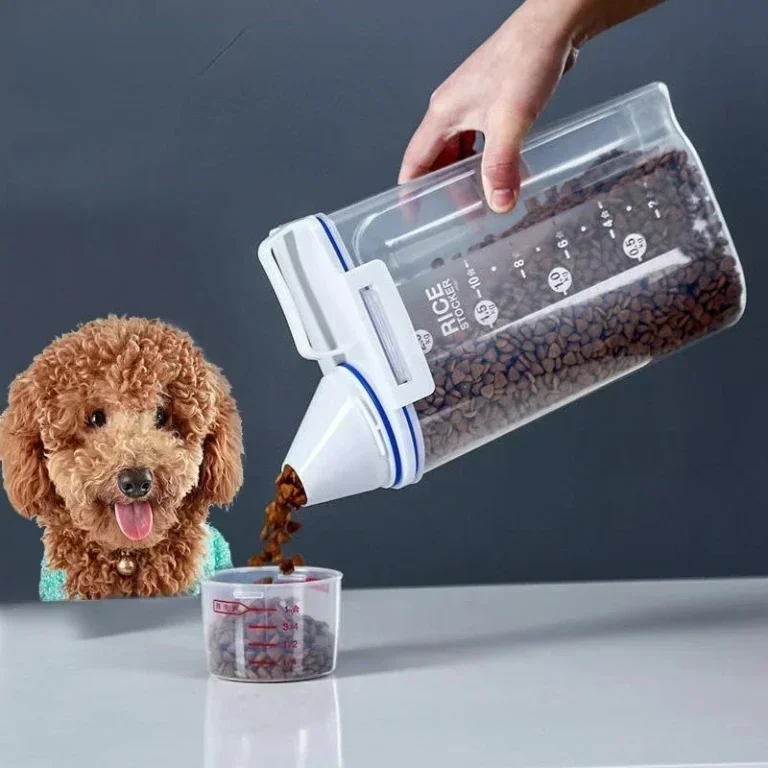
- Cost is a real factor — feeding a 40kg dog well is a monthly expense that shapes which foods are realistic, and buying the larger bag only pays off if it stays fresh in an airtight container
- Growth must be controlled — this is the single biggest feeding issue in large breeds, covered in the puppy section below
- A long growth window — giant breeds are not skeletally mature until eighteen to twenty-four months
- Bloat risk — deep-chested breeds face a life-threatening condition that feeding management can influence
- Joints pay for extra weight — every excess kilo loads hips and elbows already carrying a heavy frame
- Hard chews fracture teeth — a powerful jaw plus an antler or weight-bearing bone is the classic cause of a slab fracture on a carnassial tooth
Small Versus Large, Side by Side
| Factor | Small breeds (under 10kg) | Large breeds (over 25kg) |
|---|---|---|
| Calories per kg of body weight | Higher | Lower |
| Meals per day, adult | 2 to 3 | 2 |
| Reaches adult size | 9 to 12 months | 18 to 24 months |
| Kibble size | Small, to encourage chewing rather than swallowing whole | Larger, to slow eating down |
| Biggest dietary risk | Toxin dose and hidden overfeeding | Growing too fast as a puppy |
| Main dental concern | Crowding and gum disease | Fractured teeth from hard chews |
| Bloat risk | Low | Significant in deep-chested breeds |
| Puppy calcium sensitivity | Low | High, needs controlled levels |
| Cost to feed well | Low | High |
How Much Food Per Day
Daily energy needs scale with body weight, but not in a straight line. Doubling a dog’s weight does not double its food. The figures below are a starting point for a healthy, neutered adult dog. The lower end suits a quiet dog, the upper end an active one.
| Body weight | Approximate calories per day | Ten per cent treat allowance |
|---|---|---|
| 2kg | 165 to 210 kcal | About 19 kcal |
| 5kg | 330 to 420 kcal | About 37 kcal |
| 10kg | 550 to 710 kcal | About 63 kcal |
| 20kg | 925 to 1190 kcal | About 106 kcal |
| 30kg | 1255 to 1615 kcal | About 144 kcal |
| 40kg | 1560 to 2000 kcal | About 178 kcal |
| 50kg | 1840 to 2370 kcal | About 211 kcal |
Notice that a 50kg dog needs roughly eleven times the calories of a 2kg dog while weighing twenty-five times as much. That is the metabolic difference in action, and it is why small dogs are, per kilo, surprisingly hungry animals.
Use these numbers to sanity-check the feeding guide on your bag of food, not to replace it. Bag guides are famously generous, and they are printed for an average dog that may be far more active than yours. The dog in front of you always beats the chart.
Whatever number you land on, measure it the same way every time. A kitchen mug is not a measurement, and the gap between a level scoop and a generous one is easily a fifth of a meal. A pair of marked scoops costs almost nothing and removes the argument about whether the dog has already been fed.
Puppies: Where Size Matters Most
If there is one section experienced owners should not skip, it is this one. Adult feeding is fairly forgiving. Puppy feeding is not, and the mistakes are different at each end of the size range.
Large-breed puppies: grow slowly, stay lean
A large-breed puppy that grows too fast is building a skeleton it cannot properly support. Overfeeding, and particularly excess calcium, is linked to developmental orthopaedic disease: hip and elbow dysplasia, osteochondrosis and related joint problems that show up later as lifelong lameness.
The mechanism matters. Young large-breed puppies cannot down-regulate calcium absorption the way adults can, so if you give them more, they absorb more, and the growing skeleton pays for it. This is why the advice for a Great Dane puppy is the opposite of what instinct suggests.
- Feed a food formulated for large-breed growth — the label should state it is suitable for growth of large size dogs, meaning 70lb or more as an adult
- Never add a calcium supplement — a complete puppy food already has the right amount, and topping it up causes the exact harm you are trying to prevent
- Keep the puppy lean, visibly so — a chubby large-breed puppy is not thriving, it is at risk
- Resist the urge to push growth — a puppy that reaches its adult size more slowly ends up just as big, with better joints
Toy-breed puppies: feed little and often
The opposite problem applies at the small end. Toy-breed puppies have minimal fat reserves and a high metabolic rate, which leaves them vulnerable to hypoglycemia, a sudden drop in blood sugar. It can develop within hours of a missed meal, and it is a genuine emergency.
Signs are wobbliness, weakness, glazed eyes, unusual sleepiness, and in severe cases seizures or collapse. If you see them, rub a little honey or glucose syrup onto the gums and get to a vet immediately. Do not pour liquid into the mouth of a dog that is not fully conscious.
Prevention is simple: feed small amounts frequently, never let a toy puppy go long stretches without food, and make sure whoever else looks after the puppy knows the same.
Meals per day, and when to switch to adult food
| Age | Meals per day | Notes |
|---|---|---|
| 6 to 12 weeks | 4 | Toy breeds may need feeding every 3 to 4 hours |
| 3 to 6 months | 3 | Drop to three once weight gain is steady |
| 6 to 12 months | 2 | Most dogs settle into twice daily here |
| Adult | 2 | Small dogs often do better on 3 smaller meals |
| Adult size | Switch to adult food at | Why |
|---|---|---|
| Small, under 10kg | 9 to 12 months | Skeletal growth finishes early |
| Medium, 10 to 25kg | About 12 months | Straightforward middle ground |
| Large, 25 to 40kg | 12 to 18 months | Growth plates close later |
| Giant, over 40kg | 18 to 24 months | Prolonged growth needs controlled nutrition throughout |
Switching too early is the common error with large breeds. Adult food does not have the nutrient profile a still-growing skeleton needs, and a fourteen-month-old Rottweiler is still building bone even though it looks fully grown.
Whenever you change food, transition over seven to ten days, moving from a quarter new food, to half, to three quarters, to all of it. Abrupt changes cause diarrhoea in most dogs and will make you think, wrongly, that the new food does not agree with them.
For Experienced Owners: The Parts That Are Still Debated
If you have kept dogs for years you already know the basics. These are the areas where the advice has changed, where the evidence is genuinely unsettled, or where confident opinions outrun the research.
Body condition scoring beats the scales
Weight alone tells you very little across breeds. Body condition scoring is the skill worth having, and it takes ten seconds with your hands.
- Ribs — you should feel them easily under a thin layer, like the back of your hand. If you have to press, the dog is overweight. If you can see them clearly on a short-coated dog, it is too thin
- From above — there should be a visible waist behind the ribs
- From the side — the belly should tuck up toward the hind legs rather than running level
On the standard nine-point scale you are aiming for four or five. Do this monthly. Weight creeps on too slowly to notice by eye, and it creeps on fastest in the dogs whose owners are most confident nothing has changed.
Bloat, and the raised bowl question
Gastric dilatation-volvulus is the emergency that haunts owners of deep-chested breeds: Great Danes, Standard Poodles, Weimaraners, Setters, German Shepherds and similar. The stomach fills with gas and twists, cutting off blood supply. Untreated it is fatal within hours. Signs are a distended abdomen, unproductive retching, restlessness and drooling. This is a same-hour emergency, not a wait-and-see.
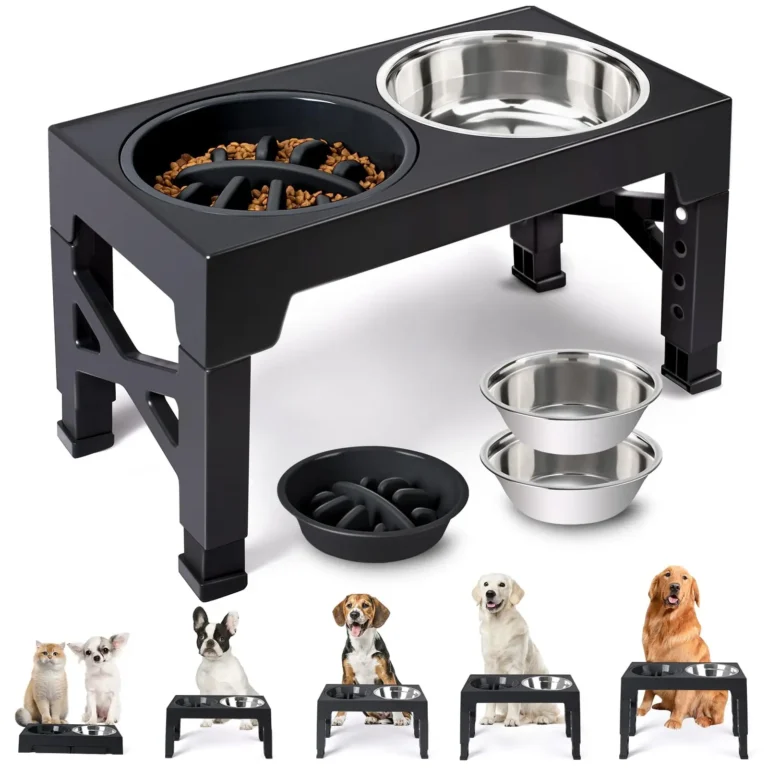
Feeding management that is broadly agreed to help: split the daily ration into two or more meals rather than one large one, slow down fast eaters with a slow-feeder bowl, and avoid vigorous exercise immediately before and after eating.
The raised bowl question is less comfortable, and worth stating plainly. A large observational study at Purdue found that raised feeding bowls were associated with an increased risk of bloat in large and giant breeds, which is the opposite of what raised feeders are often marketed to do. That study is observational rather than experimental, the finding has been debated since, and elevated bowls remain genuinely useful for dogs with megaesophagus, arthritis or mobility problems. But if you have a deep-chested giant breed, this is a conversation to have with your vet rather than a decision to make from a product description, including ours.
For the highest-risk breeds, ask your vet about preventive gastropexy, often performed at the same time as neutering. It does not prevent the stomach bloating but it largely prevents the twist, which is the part that kills.
Grain-free and the DCM question
From 2018 the US Food and Drug Administration investigated a possible link between dilated cardiomyopathy and diets heavy in peas, lentils, chickpeas and potatoes, many of them marketed as grain-free. Cases appeared in breeds with no genetic predisposition to the disease, which is what raised the alarm.
Where it stands now: no causal mechanism has been established, the FDA stopped issuing routine updates in 2022, and research continues without a settled answer. Some affected dogs improved on a diet change, which is suggestive but not proof.
The practical position most veterinary cardiologists take is straightforward. True grain allergy in dogs is rare, so unless your dog has a diagnosed reason to avoid grains, going grain-free buys you nothing and puts you in a category still under investigation. If you feed grain-free and your dog is thriving, this is worth raising at the next check-up rather than panicking about.
Raw feeding, honestly
Raw diets have committed advocates and the arguments get heated. The evidence position is narrower than either side usually admits: claimed health benefits are largely anecdotal and not well supported by controlled research, while the risks are documented.
- Bacterial contamination — salmonella, listeria and campylobacter are found regularly in commercial raw products, and dogs can shed them without appearing ill
- Household risk — that matters most in homes with young children, elderly or immunocompromised people
- Nutritional balance — a raw diet that is not properly formulated drifts out of balance, and puppies are least able to tolerate that
- Bones — raw bones splinter less than cooked, but fractured teeth and obstructions still happen
If you feed raw, use a product formulated to meet a recognised nutritional standard, handle it with the same hygiene you would raw chicken for yourself, and tell your vet so it is on the record.
Homemade diets need formulating, not improvising
Cooking for your dog is a reasonable thing to want to do. The problem is that studies assessing homemade recipes from books and websites have repeatedly found most of them deficient in one or more essential nutrients, often calcium, and the deficiency takes months to show.
If you want to feed home-cooked long term, have the recipe formulated by a board-certified veterinary nutritionist and follow it precisely, including any supplement. Swapping ingredients because the shop had no sweet potato is what unbalances an otherwise sound diet.
Allergy or intolerance, and how it is actually diagnosed
True food allergy is less common than the internet suggests, and it is usually a reaction to a protein the dog has eaten for a long time: beef, dairy and chicken more often than grain. Signs are typically itchy skin, recurring ear infections and paw licking rather than dramatic digestive upset.
It is diagnosed by a strict elimination diet for eight to twelve weeks, using a novel or hydrolysed protein and absolutely nothing else, followed by a deliberate rechallenge. Blood, saliva and hair tests sold for food allergy are not reliable, and a common way to waste months is to spend them on a test result rather than an elimination trial.
Seniors: less energy, not less protein
Older dogs generally need fewer calories as they slow down, and portions should come down to match or they gain weight on the same bowl they have always had.
Protein is where the advice has changed. The old guidance to restrict protein in healthy older dogs has not held up. Ageing dogs lose muscle mass, and adequate good-quality protein helps preserve it. Protein restriction belongs to specific diagnosed conditions such as advanced kidney disease, prescribed by a vet, not to old age by itself.
Treats and Chews, Sized Properly
Chews are where size mistakes turn into vet bills, and the failure mode differs at each end. Small dogs choke on chews that are too big. Large dogs swallow chews that are too small, and fracture teeth on chews that are too hard.
| Chew or treat | Small dogs | Large dogs | Main risk |
|---|---|---|---|
| Dental chews | Good, if sized for the breed | Good, if sized for the breed | Wrong size in either direction; look for veterinary-accepted products |
| Bully sticks | Fine, in short sessions | Fine, in short sessions | Calorie-dense; remove the end stub before it is swallowed |
| Carrot, frozen green beans | Excellent | Excellent | Very low risk, very low calorie |
| Rawhide | Best avoided | Best avoided | Swells when swallowed; a common cause of obstruction |
| Antlers, hooves, weight-bearing bones | Avoid | Avoid | The classic cause of fractured carnassial teeth in powerful jaws |
| Cooked bones of any kind | Never | Never | Splinter into sharp fragments |
| Cheese, sausage, hot dog | Tiny amounts only | Small amounts | Very high calorie and salt; blows the ten per cent budget fast |
Two rules cover most of it. The thumbnail test: if you cannot dent the surface with your thumbnail, it is hard enough to break a tooth. The swallow test: if the whole item could fit inside your dog’s mouth, it is a choking hazard for that dog.
Reading the Label Properly
Front-of-bag marketing is designed to sell. The information that matters is on the back, and most of it is in one small paragraph.
- The nutritional adequacy statement — the single most important line. It should say the food is complete and balanced for a named life stage. If it says the food is for intermittent or supplemental feeding, it is not a diet, it is a topper
- Life stage — growth, maintenance, or all life stages. All life stages means it is formulated for growth, which can be richer than a quiet adult dog needs
- The large-breed growth line — for a large-breed puppy, look specifically for wording covering growth of large size dogs, 70lb or more as an adult
- Calorie content — given per kilogram and usually per cup. This is the number you portion with, and the one that lets you compare two foods honestly
- Guaranteed analysis — useful, but quoted as fed. A wet food showing 10 per cent protein is not weaker than a kibble showing 26 per cent; it is mostly water. To compare properly, convert both to a dry matter basis
To convert to dry matter, divide the nutrient percentage by the dry matter percentage, which is 100 minus the moisture, then multiply by 100. That 10 per cent protein wet food at 78 per cent moisture is 45 per cent protein on a dry matter basis, comfortably ahead of the kibble.
One caution on ingredient lists. They are ordered by weight before cooking, so fresh meat sits near the top while carrying most of its weight as water, and much of that is lost in processing. A related trick is ingredient splitting, where one ingredient appears several times in different forms so each entry ranks lower. The ingredient list is worth reading but it is a weaker signal than the adequacy statement.
If Your Dog Eats Something It Should Not
Act on this immediately rather than searching for reassurance. With most toxins, treatment is far more effective before symptoms appear.
- Call your vet or an animal poison line straight away — do not wait for symptoms, particularly with a small dog
- Have four facts ready — what it was, roughly how much, when it happened, and your dog’s weight
- Keep the packaging — it tells the vet the exact ingredients and concentrations
- Do not induce vomiting unless told to — it is dangerous with caustic substances, and home remedies can cause serious harm on their own
- Save the out-of-hours number now — put it in your phone before you need it, because these things happen on Sunday nights
The Short Version
- The toxic list is the same for every dog. Only the dose that causes harm changes with size
- A complete, balanced food does the heavy lifting. Extras stay under ten per cent of daily calories
- Small dogs have almost no margin for error on toxins, treats or missed meals
- Large dogs need controlled, unhurried growth as puppies, and never a calcium supplement
- Feed plain, introduce new foods one at a time, and change foods over seven to ten days
- Check body condition with your hands monthly. The scales will not tell you in time
- Match chew hardness and size to the dog, using the thumbnail and swallow tests
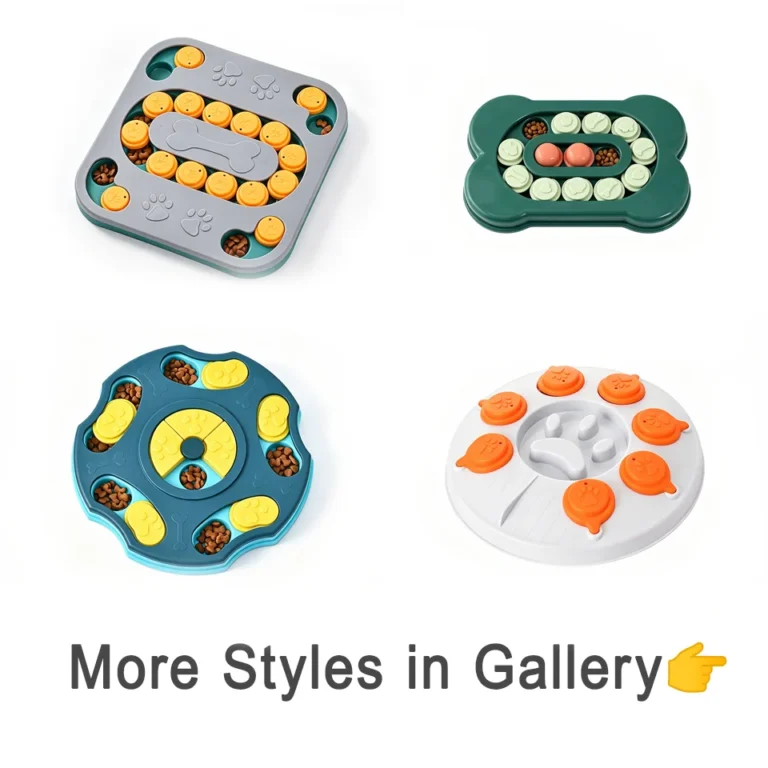
Browse the feeding and care gear we list, from slow feeders to storage: Feeding & Care.
This guide is general information, not veterinary advice. Dogs with medical conditions, and any dog on a prescription diet, need feeding plans agreed with a vet. If your dog has eaten something harmful, or you are worried about their weight, appetite or health, contact your vet.