



Bell sleeps on our bed. She usually starts at the feet, mine or my wife’s, and some time in the night, once she has got too warm, she gets down onto the floor and falls asleep there on her back. That turns out to be a fairly good summary of what the research says about dogs in beds: mostly fine for people, mildly worse for sleep, and something the dog will adjust for itself if you let it.
If you share your bed with a dog, you are in large company. A review of the subject estimated that somewhere between 14% and 62% of pet owners let their animals on the bed, depending on the country and the survey. Here is what is actually known.
Does a dog in the bed make you sleep worse?
A little, by the one objective measure we have. In a 2017 Mayo Clinic study, 40 healthy adults and their dogs wore activity trackers for seven nights. People slept slightly less efficiently when the dog was on the bed (about 80% of time in bed spent asleep) than when it was elsewhere in the bedroom (about 83%). The dogs’ own sleep was the same wherever they slept. The authors’ conclusion was that a dog in the bedroom is not the problem people assumed; on the bed costs you a little sleep.
It was a small study, over one week, with no group of people sleeping without dogs to compare against, so treat the gap as a hint rather than a verdict.
Why so many people prefer it anyway
In a 2018 survey of 962 women in the United States, more than half shared their bed with at least one dog. Dogs were rated as less disruptive bed partners than either cats or human partners, and as giving a stronger sense of comfort and security than both. That is self-reported, not measured, but it matches what most owners say: whatever a dog costs in sleep, it pays back in how the night feels.
Why she gets down in the night
A Shih Tzu wears a thick, continuously growing coat, and a duvet with two people under it is a warm place. Dogs cannot sweat much; they lose heat mainly by panting and by lying against something cooler than they are. A tiled or wooden floor is exactly that. Lying on her back puts her belly, where the coat is thinnest, towards the cool air, and it is usually read as a sign of a dog that feels completely safe. Our guide to how hot is too hot explains why short-faced breeds in particular run warm.
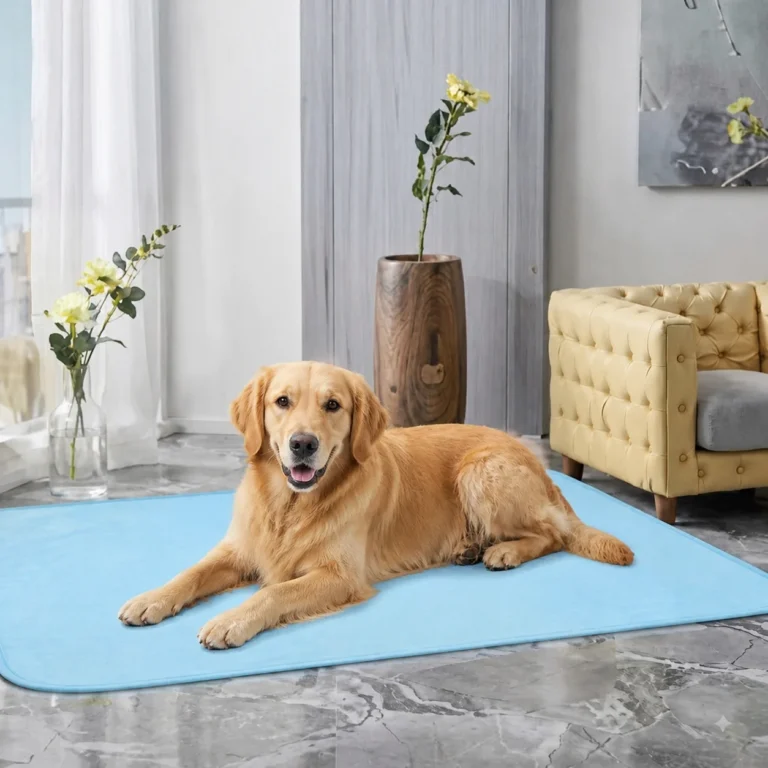
The practical point is to leave the way down open. A dog that is shut in a warm bed, or wedged under a duvet, cannot do what Bell does. If your floor is carpeted, a cooling mat beside the bed gives a warm dog somewhere better to go. It will not help a dog that is overheating for some other reason, and a dog that pants heavily at rest in a cool room should see a vet.
The honest case against
- Allergies. Keeping the dog out of the bedroom is the first thing allergy specialists recommend, because it gives you a third of the day with less exposure. Our guide to hypoallergenic dogs covers why no breed gets you out of this.
- Infections. A 2011 review of diseases passed from pets in the bedroom described real cases but called the overall risk small. Its advice was specific: young children and people with weakened immune systems should not share a bed with pets, and every dog in a bed should be kept free of fleas and worms.
- The jump. A high bed is a long way down for a small dog, several times a night. For a puppy, an older dog or one with back or joint trouble, a lower bed or a step makes more sense than a leap.
- Guarding. A dog that growls when you move, or when someone else gets into bed, should sleep in its own bed while you work on that, ideally with a trainer. It is not a reason to worry about every dog, only about that one.
One worry that does not hold up: there is no good evidence that letting a dog sleep on your bed makes it think it is in charge.
If you share, a few things make it easier
- Brush the dog before bed, especially a long coat, so less of the day ends up in the sheets. The grooming guide has the routine.
- Put a washable layer on top of the duvet where the dog sleeps. A flannel throw goes in the wash far more easily than a duvet cover. For a puppy or an older dog that may have accidents, a waterproof mattress protector underneath saves the mattress.
- Keep flea and worm treatment up to date, which matters more for a bed dog than for any other.
- Give the dog its own bed in the room too, so that sleeping somewhere else is a choice it already knows, not a punishment.
On the evidence, a dog at your feet is a perfectly reasonable arrangement for most people and most dogs, as long as the dog can always get down.
Sources: Patel SI, Miller BW, Kosiorek HE, et al. The effect of dogs on human sleep in the home sleep environment. Mayo Clinic Proceedings, 2017; Hoffman CL, Stutz K, Vasilopoulos T. An examination of adult women’s sleep quality and sleep routines in relation to pet ownership and bedsharing. Anthrozoös, 2018; Chomel BB, Sun B. Zoonoses in the bedroom. Emerging Infectious Diseases, 2011. This guide is general information, not veterinary or medical advice.