
There are three completely different products sold as “dog trackers”, and choosing badly is not a matter of getting fewer features. It is a matter of buying something that cannot do the job you bought it for. A tag that works beautifully in a busy park is useless on an empty hillside, and the expensive collar that works on the hillside is overkill for a dog that has never left the garden.
So the question is not which tracker is best. It is which of the three you actually need.
The three things, and what separates them
A name tag
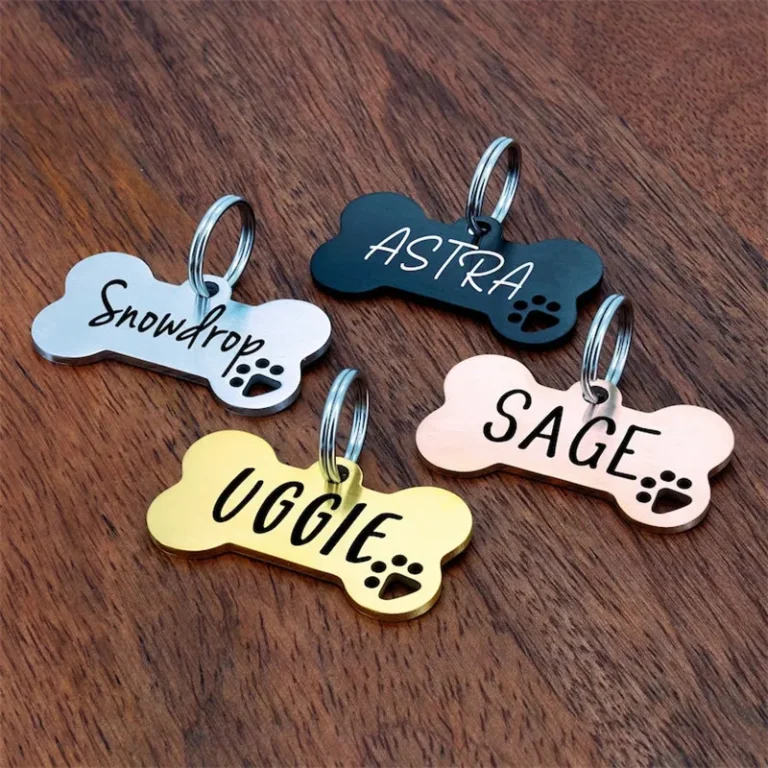
No battery, no app, no network. Somebody finds your dog, reads the tag, and rings you. For a dog picked up by a person — which is how most lost dogs are actually recovered — this is the fastest route home there is, and it costs less than a coffee. It is also the only one on this page that keeps working after three days in a hedge.
A Bluetooth tag: AirTag, Find My, Google Find My
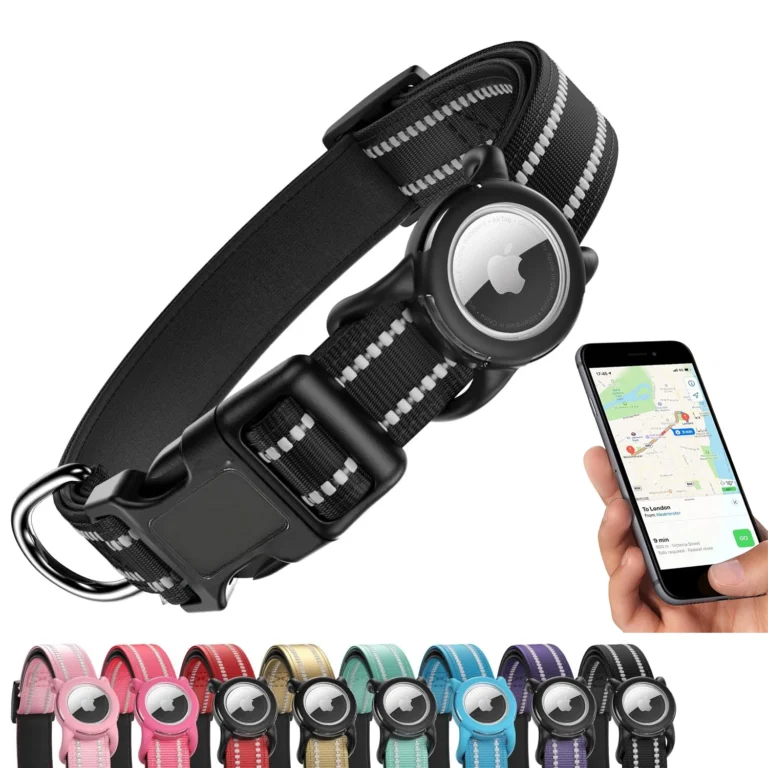
This is the category most people buy, and almost nobody understands. A Bluetooth tag has no idea where it is. It shouts its name a few times a minute, and any passing phone on the right network quietly reports the sighting back to you. In a town that means near-continuous updates, no SIM and no monthly fee, on a battery that lasts months. On an empty moor at dusk it means nothing at all, because there is no phone to hear it. What you get is not a live position; it is a last-seen pin from whenever the last stranger walked past.
Which one you want is decided by your phone, not by the tag. Apple’s Find My network runs on iPhones; Google’s runs on Android handsets. Buying the wrong one gives you a small plastic square that does nothing.
A GPS collar
This one genuinely knows where it is. It receives satellite signals, works out its own position, and then — this is the part the listings skip — needs a mobile connection to tell you. That means a cellular radio, a SIM card, and in most cases a monthly plan. It gives a live position and movement alerts, and it is the only category that works where there are no other people. It also needs charging every few days and depends on mobile coverage in exactly the remote places you are most likely to need it.
Compared, with what is on this site
| Price | Needs | Battery | Where it works | |
|---|---|---|---|---|
| Engraved steel ID tag | $2.63 | Nothing | None | Anywhere a person finds your dog |
| Silicone tracker holder | $1.70 | A tag you already own | n/a | Holds a tag on a collar you like |
| Google Find My collar tag | $5.13 | An Android phone | Months, coin cell | Towns and busy parks |
| Padded AirTag collar | $9.32 | An AirTag, bought separately | Months | Towns and busy parks |
| Find My Bluetooth tracker | $9.53 | An iPhone | Months | Towns and busy parks |
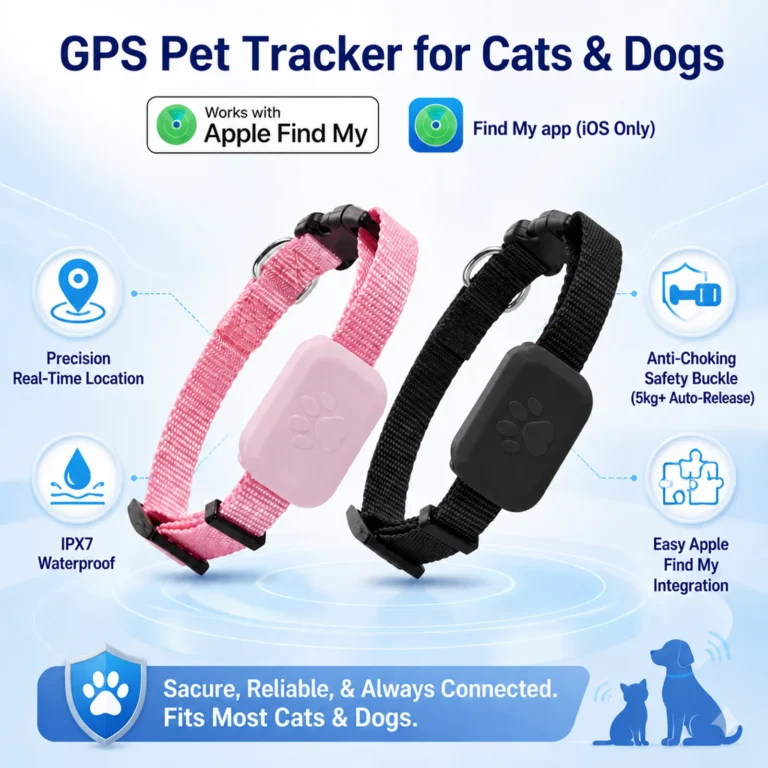
| Waterproof GPS tracker | $8.62 | Possibly a SIM and a plan | Days, rechargeable | Open country, if there is signal |
| Wireless boundary system | $44.77 | Setup and training | Days, rechargeable | Containment, not finding |
Prices are what the sellers were asking when this was written, and they move. The figures on each product page carry the date they were read.
The price test, and a warning about our own listing
A real GPS tracker contains a satellite receiver and a mobile radio, and the mobile radio needs a SIM with data on it. That hardware and that connection cost money every month. So here is a rule that will save you a disappointment:
If something is sold as a GPS tracker for under about fifteen dollars and the listing never mentions a SIM or a subscription, treat the word GPS as marketing until proved otherwise. Either it is a Bluetooth tag wearing the wrong name, or there is a monthly fee that has not been mentioned yet.
That test points straight at a product on this site. The waterproof GPS tracker we list at $8.62 is cheap enough to fail it, which is why its own page says, in as many words, to check whether it needs a SIM or a subscription before you buy. We are not going to pretend that is a solved question because the item is on our shelf. Ask the seller before ordering, and if the answer is vague, buy the Bluetooth tag that matches your phone instead and spend the difference on a longer lead.
What none of them do
- None of them stop a dog leaving. They tell you about it afterwards. The thing that keeps a dog with you is a recall that has been practised, and that is a training problem, not a hardware one.
- None of them survive the collar coming off. Every device here is attached to a collar, and a collar caught on a fence is exactly how dogs go missing. A microchip is the only identification that stays with the dog, and no tracker replaces one.
- A boundary system is containment, not tracking. It is a different product answering a different question, and when a containment system fails it does not fail gently. Read its page properly before you consider one.
- None of them work flat. The Bluetooth tags go months and then die silently; the GPS collars go days. A tracker you have not charged is a decoration.
What to actually buy
- Every dog, without exception: a microchip, registered to a phone number you still use, and an engraved tag on the collar. Everything else on this page is an addition to that, never a replacement for it.
- A town or suburban dog: the Bluetooth tag that matches your phone. Android owners the Google one, iPhone owners the Find My one. Months of battery, no fees, and where you walk there are always other phones.
- A bolter, a sighthound, a scent hound, or anyone who walks in open country: a genuine GPS collar, with the subscription cost worked out before you buy rather than after.
- A dog that has already been lost once: both. The tag for every day and the GPS for the walks that worry you. Between them they cost less than one afternoon of searching.
The longer version of all of this, including what the training tech does and does not do, is in the trackers and training tech guide. If the real problem is a dog that will not come back, start with the recall article instead — it is the one that actually fixes something.