
This is a page nobody wants to need. If you are reading it today, you are probably tired, in shock, and being asked to make decisions you have never made before. So it is written in the order things happen, it keeps to what is useful, and nothing in it has to be done in a hurry except the first part.
The first hour
If your dog died at home and you are not completely sure, check for breathing and a heartbeat, and look at the eyes: they usually stay open, and the pupils stop reacting to light. If there is any doubt at all, ring your vet or an emergency clinic now.
Then, gently:
- Lay your dog on their side on an old towel or a puppy pad, in a natural curled position, with the legs tucked in. The bladder and bowels often release after death; that is normal, and the towel is for that.
- Close the eyes if you can. Often they will not stay fully closed, and that is normal too.
- Move them to the coolest room in the house, away from radiators and sunlight, and cover them with a light blanket.
Do this within the first couple of hours if you can. Stiffness (rigor mortis) usually begins somewhere between two and six hours after death and wears off over the following two or three days, and it is much easier to settle a small dog comfortably before it sets in.
If the death was sudden and you do not know why, tell your vet. They may suggest finding out the cause, which matters if there is another dog in the house, or if poisoning is a possibility.
The first day
You do not have to decide everything today, but you do need to keep your dog cool. In a cool room, a small dog can usually stay at home for a day, sometimes two. In warm weather the window is much shorter, around 12 to 24 hours. Ice packs or frozen water bottles wrapped in a towel and placed around the body, not directly on it, buy time.
If you need longer, your vet will almost always look after your dog for you. Ring them: this is a call they take every week, and they can arrange the cremation or hold your dog while you decide.
If there are children, tell them plainly that the dog has died. Words like “put to sleep” or “went away” tend to confuse young children more than they protect them.
Choosing what happens next
Cremation
Most owners choose cremation, usually arranged through the vet. The word that matters is the type:
- Communal: several animals are cremated together and no ashes come back to you. It costs least.
- Individual or private: your dog is cremated alone and you get the ashes back, usually in a simple container or a casket you choose. Ask the crematorium exactly what their word means, because the terms are not used consistently.
Burial at home
Burying a small dog in your own garden is allowed in many places, with conditions. In England, for example, you need to own the property (or have the landlord’s written permission), the grave needs at least a metre of soil over your dog, and it must sit well away from water: government guidance asks for at least a metre between the bottom of the grave and the water table, and distance from streams, ponds and wells. In the United States the rules are set by states and towns, so check with your local council or city before you dig.
One thing people rarely hear: if your dog was put to sleep, the drug used (usually pentobarbital) stays in the body and can poison wildlife or another dog that digs the grave up. That is the real reason for the depth. Bury deep, cover with paving or a heavy stone if foxes are about, and use a natural material such as a cotton blanket or a cardboard box rather than plastic.
A pet cemetery
If you rent, may move house, or would simply like a place to visit, a pet cemetery gives you a grave that stays. It costs more than cremation, and your vet will know the ones nearby.
Keeping something of them
Some of these can only be done before the burial or cremation, so it is worth deciding early, even if the rest waits.
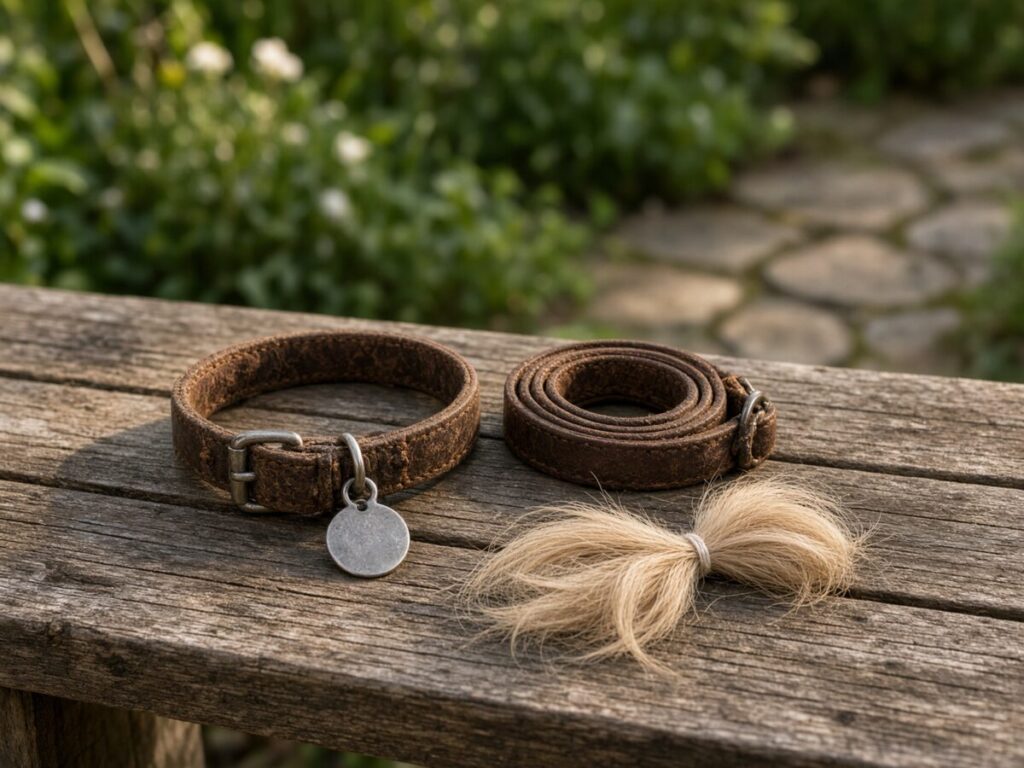
- A lock of the coat. With a long-coated dog this is the keepsake many owners treasure most. Take it from somewhere hidden, such as behind an ear or the back of the neck. Tie the lock tightly with thread before you cut, above the tie, so it stays together, then keep it in an envelope or a small box.
- A paw print. Many vets and crematoria offer a clay or ink print. Ask before your dog leaves your care.
- The collar and tag. Keep them as they are. Small things that carry a smell are often the ones people hold on to.
Later, when you are ready, a marker in the garden can give the grief somewhere to go: a corner by a path, a favourite sunny spot. Something light that sits on the ground, rather than a heavy headstone, also works if the garden is not where your dog is buried.
A heart-shaped memorial stone for a garden or a path, with the words ‘No longer by our side, but forever in our hearts’. It is resin rather than real stone, so it is light and will not mark a lawn.
As an Amazon Associate I earn from qualifying purchases.
If you have another dog
Dogs notice. In a 2022 study of 426 owners in Italy, 86% saw negative changes in the surviving dog after a companion died: more attention-seeking, less play, less activity. For a third of them it lasted two to six months. The closer the two dogs were, the stronger the change, and the owner’s own grief made it more likely too.
What helps is ordinary life: the same walks at the same times, meals on schedule, and a little more of your company than usual. If your other dog stops eating for more than a day or two, or seems unwell rather than flat, that is a vet visit, not grief.
Your grief
Losing a dog can hurt as much as losing a person, and it is not an overreaction. A small dog in particular is with you all day: on your lap, at your feet, often in your bed. The quiet house, the empty spot on the sofa, reaching for the lead at walk time: those are the moments that catch people out, sometimes weeks later.
If it would help to talk to someone who understands, there are free services run by people trained for exactly this:
- UK: Blue Cross Pet Bereavement Support Service, 0800 096 6606, every day from 8.30am to 8.30pm, with an online service as well.
- US: Tufts University Pet Loss Support Hotline, 508-839-7966, Monday to Friday, 6pm to 9pm Eastern; calls from outside Massachusetts are returned at no charge.
There is no right time for another dog, and no rule that there has to be one. If and when it happens, it will not replace this one, and it is not meant to.