


Some dogs are fine at home, fine with visitors and fine in the garden, and impossible the moment they see another dog or a stranger on the pavement. They bark, they lunge, they spin on the end of the lead, and nothing you offer them registers. Owners in this position quietly stop going places. No pub garden, no market, no walk through town. The dog stays at home, and the problem never gets worked on.
Trainers call this reactivity. It is common and it is very workable, but it is almost never fixed by distraction or by telling the dog off. What fixes it is a plan done in a particular order, and the order matters more than any single technique in it. This guide is that order.
First, Which Dog Do You Have?
On the end of a lead, two very different dogs look the same. One is desperate to get to the other dog or person and cannot. The other wants them to go away and cannot leave. Both bark and lunge. The plan below works for both, but the difference is worth spotting, because a frightened dog needs more distance and more caution.
| Sign | Frustrated greeter | Frightened dog |
|---|---|---|
| Off the lead, or with no barrier | Goes straight over to say hello, usually politely | Keeps away, hides behind you, or warns from a distance |
| Body while barking | Weight forward, tail up and loose, whining mixed in | Weight back or a freeze first, tail low or stiff, hackles up |
| Once they actually meet | Calms down quickly | Stays tense, may snap |
| What they want | Less distance | More distance |
The two are not fixed types. A frustrated dog who is punished every time they lunge can learn that other dogs predict something unpleasant, and become a frightened one. That is one of the main reasons the methods further down make things worse.
Before Any Training, Rule Out Pain
This is the step people skip, and the one most worth doing with an older dog. A 2020 review led by Professor Daniel Mills of the University of Lincoln looked at the caseloads of behaviour clinics and concluded that, as a conservative estimate, around a third of dogs referred for problem behaviour had a painful condition. At one clinic the figure was over 80%. Sore joints, a bad back, an unsettled gut and itchy skin all shorten a dog’s fuse, and a dog who is uncomfortable has less patience for a stranger leaning over them.
If the barking started or got worse recently, if your dog is getting older, or if they are stiff after a walk, book a vet check first and say why you are asking. Failing eyesight and hearing make the world more startling too. Training a dog who hurts works slowly, if it works at all.
Step 1: Stop the Rehearsals
Every lunge is practice. A dog who explodes at five dogs on a walk has had five repetitions of the habit you are trying to break, and the habit gets stronger each time. So the first job is not training. It is arranging life so the explosions happen as rarely as possible while you work on the rest.
- Walk at quiet times and in quiet places for a few weeks, even if that means driving somewhere dull.
- Make distance early. Cross the road, step behind a parked car, or turn and walk the other way before your dog reacts, not after. A cheerful “this way” and a U-turn is worth practising when nothing is around, so it works when something is.
- Take the pub, the market and the friend’s garden off the list for now. They are the goal, not the training ground.
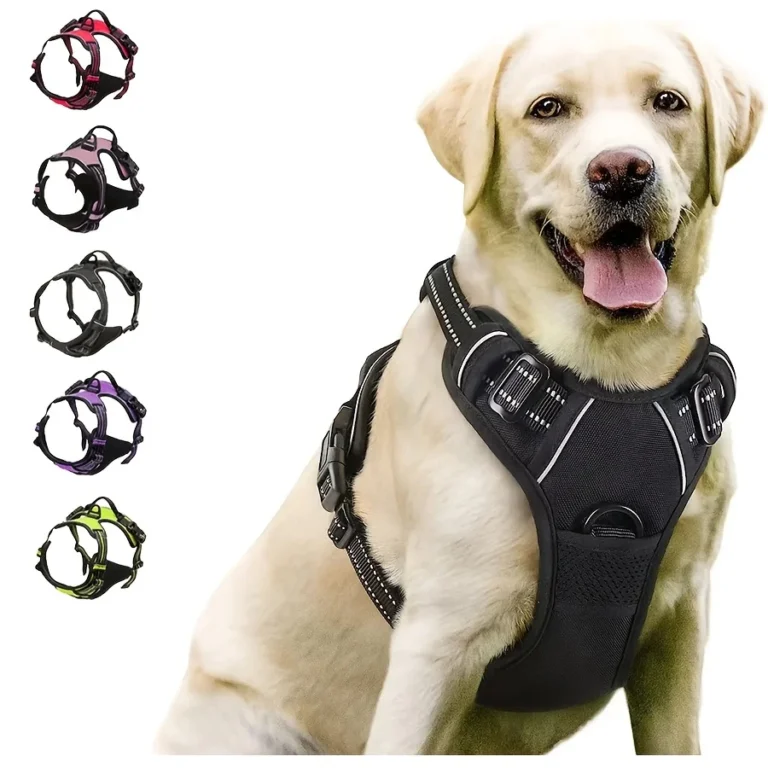
- Use gear that lets you hold on calmly. A front-clip harness turns a lunge sideways and keeps the pressure off the throat. It teaches nothing, but it takes the wrestling out of a bad moment.
- Tell people. “He’s in training, please don’t come over” is enough. A yellow lead or vest that says the same thing stops the strangers who would otherwise walk straight up with a hand out.
A front-clip harness designed by a veterinary behaviourist: the lead clips to a ring on the chest, so a lunge turns the dog sideways and nothing presses on the throat. It makes a bad moment easier to handle; it does not change how your dog feels about other dogs. Measure the chest and choose the size on the page.
As an Amazon Associate I earn from qualifying purchases.
Step 2: Find the Distance Where Your Dog Can Still Think
Every reactive dog has a distance at which they can see the trigger and stay in their own head. Trainers call the point where that stops working the threshold. Below it, a dog can learn. Above it, they cannot, and no amount of treats or commands gets through.
There is a simple test. Will your dog take a piece of food gently, and look back at you when you say their name? If yes, you are at a distance you can work at. If they snatch the food, ignore it, or cannot hear you, you are too close. That might be ten metres for one dog and the full length of a playing field for another. Start wherever the answer is yes, however far away that is.
This also answers the problem so many owners run into: “I can’t reward him for being quiet, because he never is.” At the right distance he will be, and that is where the rewarding starts.
Step 3: Teach That Other Dogs Mean Chicken
The heart of the work is changing how your dog feels when a person or dog appears, not just what they do. It is done with food, and the timing is everything.
- The trigger appears, at a distance your dog can cope with.
- The moment your dog notices it, food starts arriving: small, soft, very good pieces, one after another.
- The trigger goes out of sight. The food stops.
Done enough times, the arrival of another dog starts to predict something good, the feeling changes, and the behaviour follows the feeling. The food has to beat anything your dog normally gets: cooked chicken, cheese, a squeeze tube of something lickable. Dry biscuits will not compete with a dog across the road. Keep it in a pouch you can open with one hand, because a reward that arrives three seconds late is paying for the wrong moment.
Once that is going well, add a step. Let your dog look at the other dog, and pay them the moment they look away again. Trainer Leslie McDevitt calls this the “Look at That” game; others call it engage-disengage. It teaches your dog that seeing a trigger is the cue to check in with you, which is exactly the habit you want on a busy street.
Step 4: Closer, Slowly, and Not Every Day
Only shorten the distance when your dog is relaxed at the current one: a loose body, eating easily, looking back at you without being asked. Then move a few metres closer, not across the field.
Expect bad days. Stress adds up, so a dog who has had a loud delivery van, a strange dog at the window and a vet visit in one day will react at a distance that was fine the day before. Trainers call this trigger stacking. On a day like that, go back to an easier distance or skip the session. A day off costs nothing. A session spent lunging costs several good ones.
Keep sessions short, ten or fifteen minutes, and finish with something your dog enjoys that has nothing to do with other dogs: a sniff around an empty field on a long lead, a game, a snuffle mat at home. Sniffing settles a wound-up dog better than more walking does.
Step 5: The Garden, the Pub, the Market
This is the part you actually wanted, and it comes last. Build it the same way as everything else, from the easy end.
- A friend’s garden first, before their dog is in it, so yours arrives in a calm space. Bring the other dog in later, at the far end, on a lead.
- A pub or café at its quietest hour, at an outside table on the edge. Sit so your dog faces you and a wall rather than the room. A mat or towel they already know tells them where to settle. Stay ten minutes and leave while it is still going well.
- Markets and fairs last. They are a wall of people, dogs and food, often in narrow lanes where you cannot make distance. Walk the outside edge many times before you ever go down the middle.
Have an exit plan every time. Know where you will go if a dog comes round the corner, and go there early.
What Makes It Worse
Some of the commonest advice is the advice to ignore.
- Corrections, choke and prong collars, shouting. A University of Pennsylvania survey of 140 dogs seen at a behaviour clinic (Herron and colleagues, 2009) found that confrontational methods often drew an aggressive response: hitting or kicking in 43% of the dogs it was tried on, an “alpha roll” in 31%, a hard stare in 30%. Punishing a lunge can stop the noise while making the dog more worried about the next dog, which is how a frustrated greeter becomes a frightened one.
- “Let them meet and get it over with.” Pushing a nervous dog into a greeting is the quickest route to a bite. And a frustrated greeter who is allowed through every time learns that barking is what makes the lead go slack.
- Distraction on its own. Waving a toy or a treat at a dog who is already over threshold does not reach them. It only works at a distance where they can still take food, which is Step 2.
- A muzzle to fix the barking. A muzzle prevents bites. It does nothing about barking or lunging, and a dog who has not been taught to wear one will spend the whole outing trying to scrape it off, which winds them up further. If there is any chance your dog might bite, they should learn to wear a basket muzzle, slowly and with food, as a separate project. Our muzzle guide covers how.
- Anti-bark collars. Our guide to barking explains why deterrents harm a dog who is frightened. Reactivity is exactly that case.
When to Get a Professional
Get help early rather than as a last resort if your dog has bitten or tried to bite a person or another dog, if the reactions are getting worse despite careful work, if your dog is frightened rather than frustrated and the fear is spreading to new things, or if you simply cannot find a distance where they cope.
In the UK, look for a clinical animal behaviourist registered with the Animal Behaviour and Training Council (ABTC), ideally through your vet. In the US, look for a board-certified veterinary behaviourist (DACVB) or a Certified Applied Animal Behaviorist. Be wary of anyone who promises a fix in one session, or who explains your dog in terms of dominance.
How Long It Takes
Weeks to see a difference, months to reach a pub garden, and progress that comes in steps rather than a smooth line. Age is less of a barrier than people fear: a dog of nine or ten learns more slowly than a young one, but still learns. What makes the difference is getting the distance right and doing a little, often.
The end point is not a dog who loves every stranger. It is a dog who can see another dog across the road, look back at you, and carry on walking. That dog can come to the pub. If this is not quite your problem, the rest of our Common Problems guides may be.
This guide is general information, not veterinary or behavioural advice for your dog. If your dog has bitten, or you suspect pain, speak to your vet.